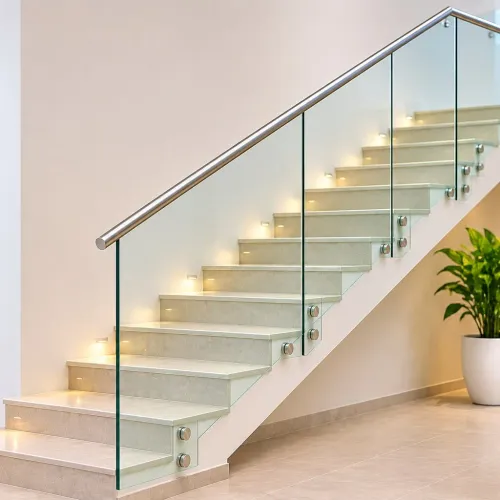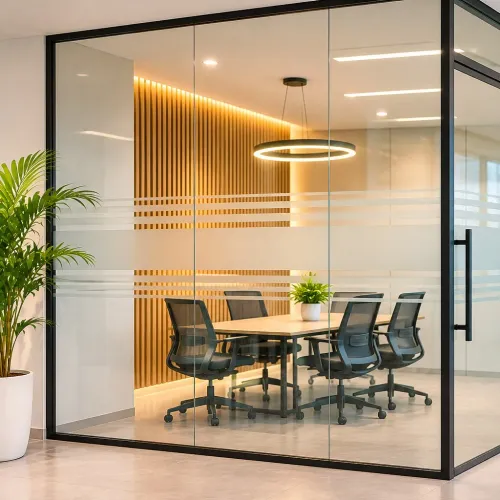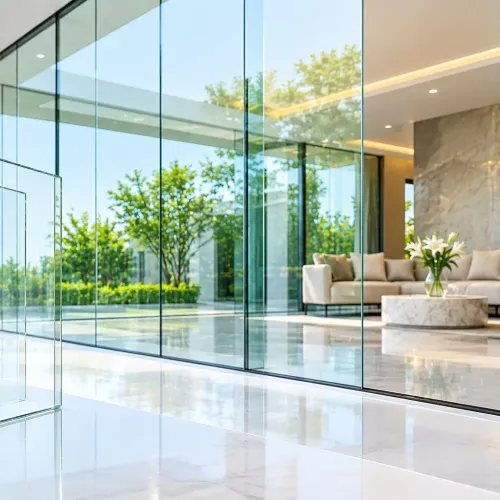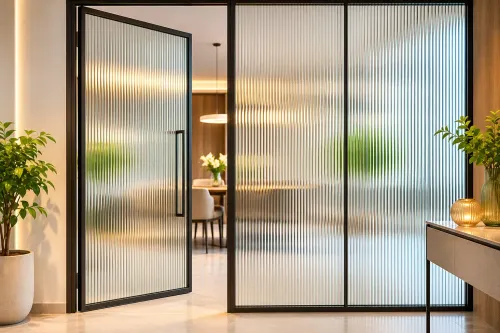
A frosted panel can soften views without blocking daylight, but its privacy depends on the finish, lighting, viewing distance, and glass construction—not on the word “frosted” alone. You will be able to match bathroom and office applications with a suitable privacy level, finish, safety build-up, and maintenance plan.
Key takeaways
- Match frosting to sightlines, lighting, and the privacy level required.
- Compare etched, blasted, printed, and applied films before choosing a finish.
- Specify laminated or toughened safety glass, edges, hardware, and dimensions.
- Plan cleaning, acoustic control, daylight, and future replacement before installation.
Where frosted glass works best in bathrooms and offices
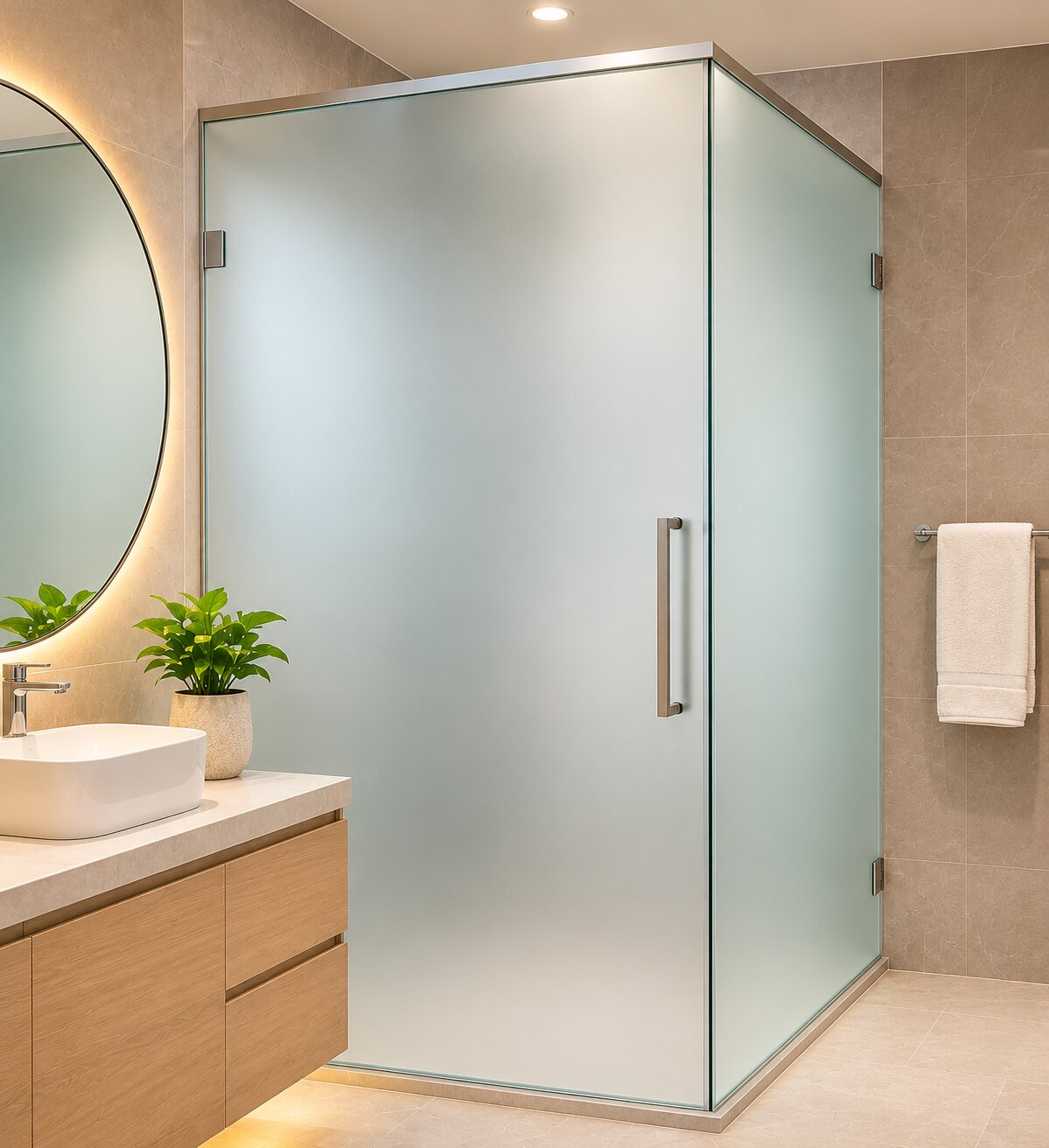
Frosted glass works best where you need daylight and privacy without completely closing a space. Suitable frosted glass bathroom applications include shower screens, toilet cubicles, bathroom windows and partitions, vanity screens, doors, and skylights. In offices, use it for meeting-room fronts, manager cabins, reception partitions, workstations, washroom doors, and sidelights.
| Application | Best coverage | Reason |
|---|---|---|
| Shower screens | Full or eye-level coverage | Hides bathing activity while preserving light; full coverage suits bathrooms facing bedrooms or corridors |
| Toilet cubicles and washroom doors | Full coverage | Protects privacy at close range, where translucent glass can reveal silhouettes |
| Bathroom windows and partitions | Partial or full, based on sightlines | Frost the lower or eye-level zone when you need daylight above it; use full coverage where nearby buildings overlook the room |
| Meeting-room fronts and manager cabins | Partial coverage | Bands, gradients, or zones at seated eye level block direct views while keeping borrowed light above |
| Reception partitions and workstations | Partial coverage | Creates boundaries without making a small office feel enclosed |
| Sidelights and glazed doors | Partial coverage with visible bands | Makes transparent surfaces easier to notice and reduces collision risk |
A translucent finish diffuses shapes but does not guarantee opacity. Someone close to the glass can remain identifiable, especially when the room is brightly lit at night and the exterior is dark. Test the actual installation from corridors, adjacent floors, and outside buildings before choosing full coverage.
Use near-opaque frosting for sensitive rooms, and reserve clear areas for daylight, wayfinding, or supervision.
Choose privacy by sightline, lighting, and visibility—not appearance alone
Choose the finish by what an observer can resolve, not by how white the sample looks. A close person, an oblique sightline, or a bright interior behind the glass can reveal more than a showroom panel suggests.
| Finish | At close range | From distance or an angle | Under changing light |
|---|---|---|---|
| translucent frosted glass | Diffuses faces and objects but can show movement, colour, and body outlines | Details usually disappear first; a close or oblique observer can still read silhouettes | A brighter room behind the pane makes occupants more visible, especially at night |
| opaque frosted glass | Blocks recognisable features and direct viewing; it may still pass diffuse daylight | Privacy stays stronger across distance and viewing angles, but transmitted light varies by product | Backlighting can reveal shadows or movement even when facial detail remains hidden |
| near-opaque privacy glass | Gives the highest visual screening while preserving little daylight | Distance adds little privacy because the view is already heavily blocked; edge gaps and uncovered areas still matter | Strong lighting differences can expose outlines, shadows, or bright objects |
Specify visible-light transmittance and haze, not just “frosted.” ASTM D1003 defines haze as the percentage of transmitted light scattered by the glass, so two panels with similar showroom appearances can produce different silhouette privacy. View full-size samples from standing, seated, and side positions.
Test the sample after dark with the bathroom or office lights on and the exterior darker. Also reverse the condition: daylight outside and lights off inside. That mock-up exposes the sightlines a catalogue image misses.
Compare etched, blasted, printed, and applied frosting methods
Choose factory acid-etched glass for high-touch doors, shower screens, and partitions that face frequent cleaning. Its smooth satin finish gives consistent privacy, resists edge failure, and shows fewer cleaning defects than heavily textured finishes.
| Method | Best surface location | Cleaning, marks, and replacement | Best visual pattern |
|---|---|---|---|
| Acid-etched glass | Exposed face, or the face receiving regular cleaning | Smooth finishes clean more easily and offer strong scratch resistance; replacement requires a new panel | Uniform satin, gradients, bands, logos, and repeatable partial coverage |
| Sandblasted glass | Place the blasted face away from direct contact where possible | Roughness holds soap, mineral scale, and oils; abrasive cleaning can damage it; replacement is panel-based | Custom murals, dense zones, and variable opacity, but inspect for directional or uneven density |
| Ceramic-frit patterns | Either face when specified by the processor; protect adjoining coatings and seals | Fired frit is durable and resists film-style peeling; fingerprints show less on patterned areas | Sharp dots, stripes, graphics, and durable partial patterns |
| Adhesive frosting film | Interior, dry, accessible face; avoid the wet side of shower glazing | Easiest to replace, but bubbles, edge lifting, scratches, discoloration, and cleaning damage remain risks | Quick gradients, temporary branding, and patterns needing later revision |
For office glazing that may be reconfigured, adhesive frosting film suits a replaceable pattern after checking insulated-glass sealant compatibility and warranty conditions. For permanent bathroom work, acid-etched glass usually offers the best maintenance balance. Specify visible-light transmittance and haze under ASTM D1003; appearance alone cannot establish silhouette privacy.
Specify the glass construction and safety details before fabrication
Set the glass build-up before approving the frosting pattern: a finish cannot correct a panel that is too weak, too reflective, or unsuitable for its frame.
| Option | Choose it when | Critical caution |
|---|---|---|
| Clear | You need neutral daylight and accurate colours | Frosting remains visible through changing backlighting |
| Tinted | You need glare or solar control | Confirm the tint’s effect on privacy and interior colour |
| Toughened frosted glass | Use it for shower doors, sidelites, doors, and hazardous locations | Cut, drill, notch, and edge-work it before heat treatment; changes afterward require replacement |
| Laminated frosted glass | You need fragments retained after breakage, such as large partitions or doors | Protect laminate edges from wet-room moisture; specify compatible interlayer, seal, and frame |
| Wired | Only where a listed fire-glazing assembly requires it | Wire alone does not make ordinary glass safe or fire-rated |
| Insulated | Use it for exterior bathroom windows or office façades needing thermal control | Frosting, spacer, seal, and frame must be compatible with the complete unit |
Before ordering, confirm the panel thickness, finished dimensions, hole locations, polished or arrissed edges, corner radius, frame support, backing colour, and whether the frosting faces the room or cavity. Frosting does not replace safety glazing: require IS 2553, EN 12150, or EN 14449 documentation as applicable.
A fire door, partition, or borrowed light needs its complete listed glass-and-frame assembly, not ordinary frosted glass.
Give Jivan Industries the hardware drawings and final opening sizes before fabrication so shower fittings, pivots, and partition brackets do not force a remade lite.
Related products
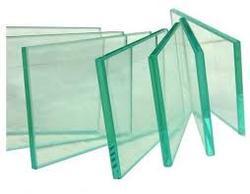 | SAFTEY Keeping full focus on the industry set quality standard, we are persistently offering an affordable spectrum of Toughened Glass to our clients in... View product → |
 | Laminated Glass is a safety and security glass that is made by sandwiching a laminated sheet between two pieces of glass. View product → |
Coordinate cleaning, acoustics, daylight, and long-term performance
Mineral scale and soap residue cling to rough frosting, making bathroom panels look permanently cloudy. For frosted glass maintenance, specify a smooth acid-etched surface where possible, use a non-abrasive cleaner, and prohibit razor blades, scouring pads, and unapproved acids. Wipe water from shower screens after use; inspect corners where deposits hide.
- Ask the processor to confirm privacy film compatibility with the glass, sealant, and insulated-glass edge seal.
- Reject film with bubbles, lifted edges, scratches, or discoloration; these failures spread and make replacement difficult.
- Check that the cleaning method will not attack the film or void the glazing warranty.
- Keep frosting separate from the thermal specification: U-factor, solar control, low-emissivity coating, gas fill, spacer, and frame determine heat flow.
- Mark large doors and sidelights with a continuous, contrasting manifestation band at the height required by the applicable accessibility rules.
Frosting does not create speech privacy. Sound privacy and STC depend on the complete partition, including glass thickness, laminated construction, mullions, frames, perimeter seals, doors, and flanking paths; STC rates the assembly, not the finish. If a partition or door needs fire resistance or radiant-heat limitation, specify the tested fire-rated glazing and frame assembly.
Do not add frosting or substitute a privacy interlayer unless that listing permits it, because the change can invalidate the approval.
Frequently asked questions
Where does frosted glass work best in bathrooms and offices?
In bathrooms, use it for shower screens, toilet cubicles, windows, partitions, vanity screens, doors, and skylights. In offices, use it for meeting-room fronts, manager cabins, reception partitions, workstations, washroom doors, and sidelights.
How should you choose a frosted glass privacy level?
Choose by sightline, lighting, and required visibility rather than appearance alone. Check what people can see through the glass from each side under both daylight and artificial light.
What is the difference between etched, blasted, printed, and applied frosted glass?
Etched and blasted finishes alter the glass surface, printed finishes add a pattern or coating, and applied frosting uses a film. Compare appearance, cleaning needs, durability, repairability, and replacement requirements.
What glass construction and safety details should you specify?
State the glass type, thickness, toughened or laminated construction, edge finish, dimensions, cut-outs, holes, hardware, and installation method before fabrication.
How should frosted glass be coordinated with cleaning, acoustics, daylight, and performance?
Select a finish that can be cleaned without damage, assess whether the glass needs separate acoustic control, check daylight levels, and confirm how the finish will perform and be maintained over time.
Keywords