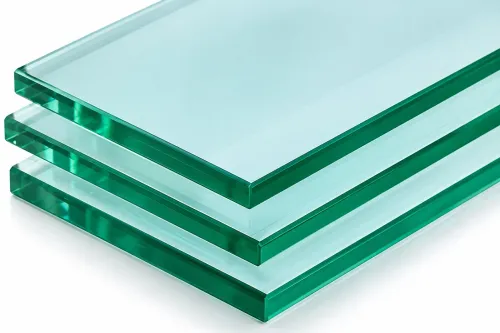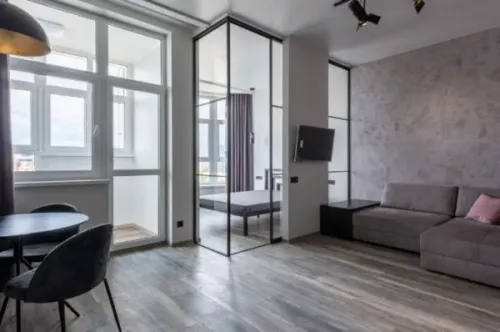
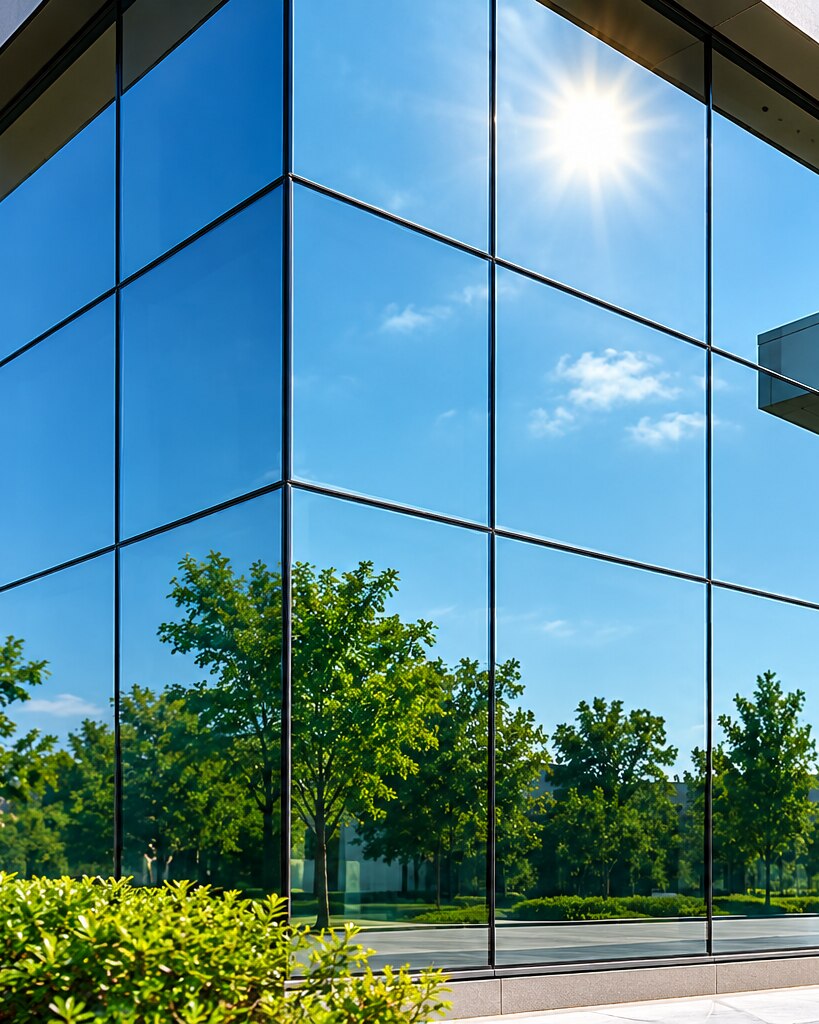
A mirrored or dark appearance does not tell you how much solar heat a window blocks, how much daylight it admits, or whether it will perform well after installation. By the end, you will be able to compare glass types, read the key performance figures, account for façade orientation, and specify a build-up that balances comfort, appearance, safety and durability.
Key takeaways
- Compare SHGC, visible transmittance and reflectance—not appearance alone.
- Use orientation, glare risk and privacy requirements to set solar-control targets.
- Specify coating position, glass layers, sealants, spacers and edge protection together.
- Require documented performance values and testable acceptance criteria before fabrication.
What reflective glass changes—and what other glazing options do differently
Reflective glass uses a reflective coating or treated surface to send part of the sun’s visible light and infrared radiation back outdoors. A shiny appearance does not identify the coating technology or its durability: specify the coating position, protected surface and compatibility with insulating-glass sealants.
| Option | What it does differently | When reflective glass is the better choice |
|---|---|---|
| Low-E glass | Reduces emissive heat transfer, often with less exterior reflection | Choose reflective glass when façade appearance, glare reduction or daytime privacy matters more than a low-reflection exterior |
| Solar-control coated glass | Controls solar gain through a coating; it may look reflective or nearly neutral | Choose reflective glass when stronger visible reflection and a defined façade aesthetic are required; compare SHGC, not shine alone |
| Tinted glass | Absorbs light and solar energy through body colour, increasing heat in the pane | Choose reflective glass when you want less absorption and more exterior privacy |
| Clear glass | Passes high daylight and solar heat | Choose reflective glass on sun-exposed façades where clear glass creates overheating or glare |
| External shading | Blocks sunlight before it reaches the glass and usually gives the strongest solar control | Choose reflective glass when projections, screens or blinds are impractical, or when you also need a consistent exterior skin |
For a low-E glass comparison, review visible transmittance, SHGC, U-factor, reflectance and colour coordinates. Large panes beside deep projections, blinds or opaque panels need thermal-stress checking; a darker or shinier surface is not proof of safe performance.
Read the numbers before choosing a darker or shinier façade
A low solar heat-gain coefficient is stronger evidence of solar control than a dark or highly reflective appearance. The NFRC SHGC includes solar energy transmitted directly indoors plus energy absorbed by the glass and transferred inside; solar reflectance alone misses the second component.
| Figure | What it tells you | What to check |
|---|---|---|
| SHGC, solar factor or g-value | Solar heat entering the space | Lower values reduce cooling load; compare the rated glass build-up |
| Visible light transmittance | Daylight passing through | Balance it against room brightness, electric-light demand and view |
| Visible reflectance | Brightness of the façade and reflected glare | Review both exterior and interior reflectance, especially near roads or neighbouring buildings |
| U-factor | Heat flow caused by indoor–outdoor temperature difference | Use the whole-window value, not only center-of-glass data |
| Colour coordinates and colour-rendering data | Tint and how accurately objects appear | Check the manufacturer’s measured values from inside and outside |
Do not choose the lowest SHGC in isolation. A coating that cuts heat aggressively can also reduce daylight, tint the view and change skin tones or interior finishes. Compare SHGC with visible light transmittance and colour data for the actual insulating-glass make-up.
Treat center-of-glass figures as a starting point. Frame material, spacer, edge effects and operating type alter the complete window’s U-factor and SHGC, while high reflectance can create off-site glare; review the façade with a sun-path and glare study before approving the appearance.
Match solar control to orientation, glare and privacy conditions
Treat an east-facing façade for low-angle morning sun, a west-facing façade for harsher afternoon sun, and a south-facing façade for higher midday sun in the Northern Hemisphere. The same glass across all elevations can leave one side overheated and another uncomfortably dark.
| Orientation | Main exposure | Practical response |
|---|---|---|
| East-facing façade | Low-angle morning sun, early glare, changing views | Combine moderate solar control with vertical fins, blinds or adjustable shades; protect nearby occupants from reflected sunlight. |
| West-facing façade | Low-angle afternoon sun, strong glare and late heat | Use stronger solar control and exterior shading; check road approaches and neighbouring buildings for reflected sunlight. |
| South-facing façade | Higher sun angles and longer seasonal exposure | Use horizontal overhangs or fins, then select glass by SHGC and visible transmittance rather than appearance alone. |
A low shading coefficient or low SHGC reduces heat gain, but excessive reflectance can create glare for drivers, pedestrians and adjacent workspaces. Review sun-path diagrams against streets, traffic signals and occupied windows; concave or curved façades need a glare study because they can concentrate reflected sunlight.
Treat privacy separately by time of day. Reflective glass can provide useful daytime screening when the exterior is brighter, but it does not prevent views in at night when interior lights are on.
Pair it with blinds, frit, layout changes or a privacy film where night-time privacy matters, and verify the effect on visible transmittance and colour.
Specify the complete glass build-up, not just the coating name
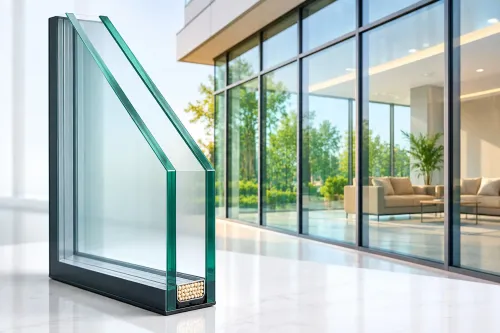
Start with the complete assembly, because a reflective coating cannot rescue a weak frame or an undersized pane. Choose single glazing only for low-demand, sheltered applications; a DGU usually delivers a lower whole-window U-value and better interior comfort.
| Option | Recommended build-up | Main decision |
|---|---|---|
| Single glazing | One reflective lite, thickness sized for wind load | Use only where thermal performance and condensation risk are acceptable |
| DGU | Reflective or low-E outer lite, sealed cavity, inner lite | Use for occupied façades requiring lower heat transfer |
| DGU with argon fill | Sealed cavity with argon fill and warm-edge spacer | Choose when the thermal model shows a worthwhile U-value improvement over air |
| Safety DGU | Heat-strengthened, fully tempered or laminated lites as required | Select from impact location, breakage risk and governing code |
Specify pane thickness from the project’s wind and load calculation, not area alone. ASTM E1300 accounts for glass type, supported dimensions, aspect ratio, load duration and supports; curtain-wall fabricators must check the actual make-up.
Name the coating surface, not merely “reflective glass.” In a DGU, surface 2 and surface 3 produce different solar, thermal and appearance results, so approve the manufacturer’s optical and thermal model before production.
Use a thermally broken frame, compatible gaskets, drained rebates and a warm-edge spacer when condensation control matters. Check the complete assembly U-value, not the centre-of-glass figure.
Use fully tempered glass where small breakage particles are required; heat-strengthened glass is not an equivalent safety substitute. Use laminated construction where post-breakage retention is required, and verify impact classification under the governing code.
Turn the performance brief into a buildable, testable façade specification
Before ordering reflective glass, turn every visual, structural, thermal and safety target into an approved sample, named test or calculation. Otherwise, two compliant products can produce different elevations, while a strong pane can still fail its safety duty.
1. Approve a full-size visual mock-up or production sample. Record the glass make-up, coating technology and position, substrate tint, visible light transmittance, solar reflectance, exterior reflectance, colour rendering and acceptable colour variation. Require batch control across all elevations.
2. Request NFRC-rated solar heat-gain coefficient (SHGC), U-factor and visible transmittance. Do not use solar reflectance as a substitute: SHGC includes directly transmitted solar energy and heat absorbed by the glass and transferred indoors.
3. Have the actual pane size, thickness, aspect ratio, support, edge cover, load duration and frame system checked to ASTM E1300. Area alone is not a load calculation.
4. Name the safety construction by location and governing code. Verify 16 CFR Part 1201 Category I or Category II where it applies. Do not treat heat-strengthened glass as interchangeable with fully tempered glass; specify laminated construction separately when post-breakage retention is required.
5. Confirm thermal-stress analysis for frame shadows, mullions, heaters and temperature differences. Check coating compatibility with sealants, spacers and cleaning materials.
Jivan Industries can use this schedule to distinguish a DGU, toughened or laminated build-up by the performance each elevation needs, not by appearance alone. Require shop drawings, labels, warranty documents, inspection records and a site mock-up before release.
Frequently asked questions
What does reflective glass change compared with other glazing options?
Reflective glass sends part of visible light and infrared radiation outdoors, changing solar heat gain, daylight, glare and exterior appearance. Low-emissivity glass mainly reduces long-wave heat transfer, while tinted glass absorbs more solar energy.
Which numbers should you compare when choosing reflective glass?
Compare solar heat gain coefficient, visible transmittance, exterior visible reflectance, interior visible reflectance, U-factor and colour data. A darker or shinier appearance does not reliably indicate the best solar-control performance.
How should you match reflective glass to a building’s orientation?
Assess façade orientation, sun angles, surrounding reflections, interior screens and occupant sightlines. East and west façades face low-angle morning and afternoon sun, while south-facing façades require a different shading and solar-control strategy.
What must a complete reflective-glass specification include?
State the glass make-up, coating surface and position, pane thickness, heat treatment, interlayer, insulating-glass cavity, spacer, sealants, edge deletion, visible and solar performance values, colour limits and inspection tests.