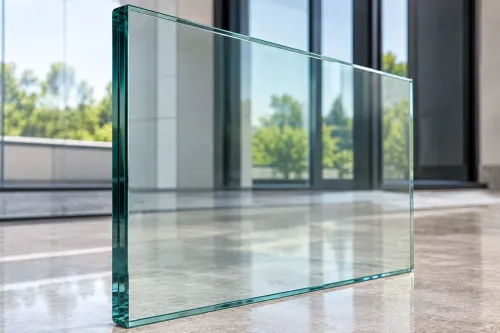
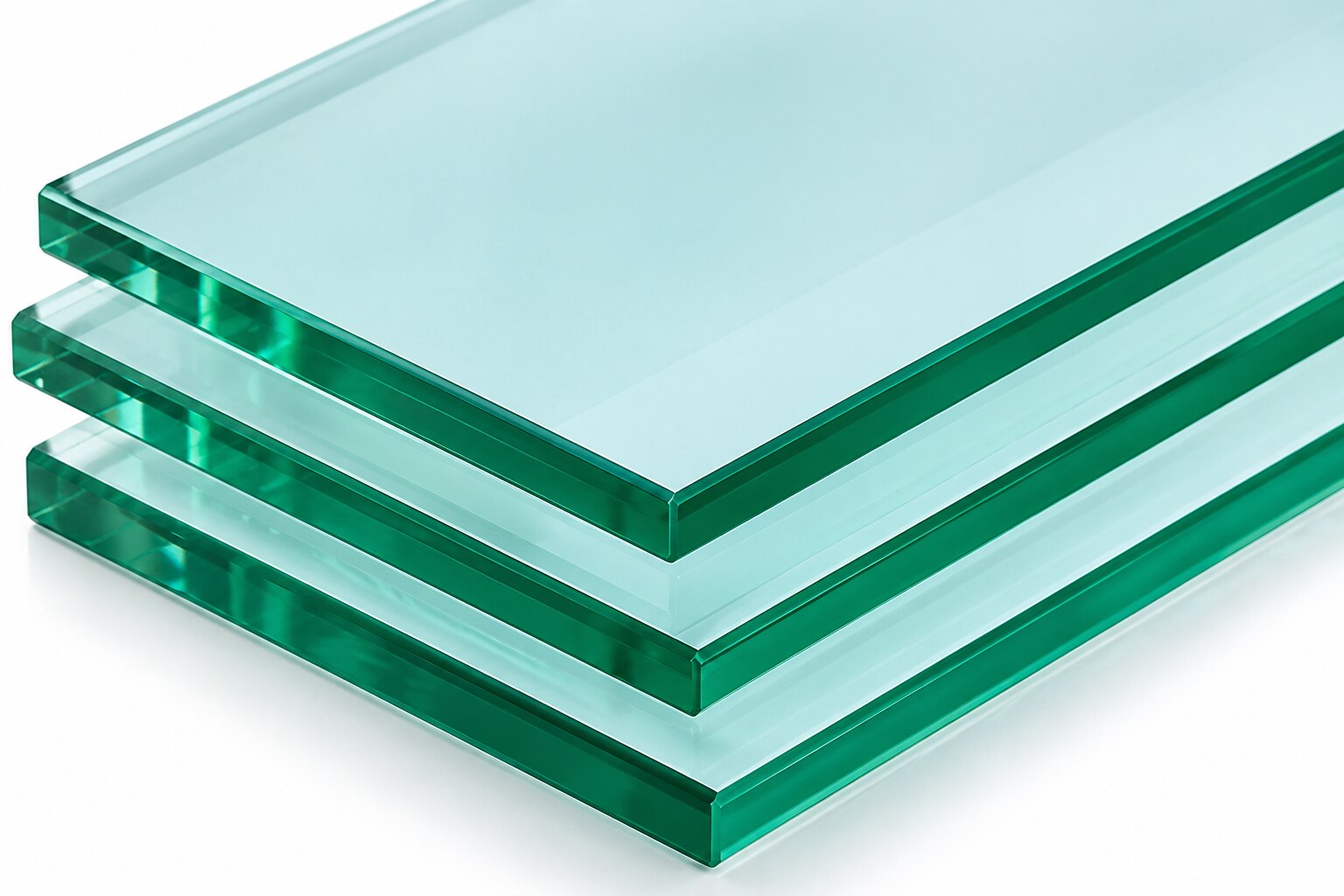
Glass safety depends on what happens when a pane is hit, how it is supported, and whether it must remain in place after breaking. By the end, you will be able to distinguish reduced-shard-risk glazing from containment and security systems, identify suitable applications, and specify the checks needed before installation.
Key takeaways
- Choose toughened glass where bending strength and safer breakage are required.
- Use laminated glass when fragments must remain attached after breakage.
- Match glass type, thickness and dimensions to the application and supports.
- Inspect edges, holes, fittings and damage before accepting the installation.
How heat treatment changes glass breakage
Fully toughened glass is typically four to five times stronger in bending than annealed glass of the same thickness. Tempered glass is another name for this heat-treated material; its greater bending strength comes from a stress pattern created during rapid cooling.
| Glass type | Stress pattern | Breakage result |
|---|---|---|
| Annealed glass | Little deliberate compressive stress at the surface | Large, sharp shards that can act like knives |
| Toughened glass | Compressive stress at the surface and tensile stress inside | Many small, relatively blunt fragments |
The surface compression helps the pane resist bending and delays cracks from opening. If a crack does overcome that compression, the stored tensile stress inside the pane drives rapid fragmentation across the glass. That is why toughened glass usually produces blunt fragments instead of the long, knife-like shards associated with annealed glass.
The safety improvement has limits. Toughened glass can still injure someone during breakage, and it loses its ability to act as a barrier once it shatters; it is not burglar-resistant glass.
Do not confuse tempering with heat-soak testing: heat soaking is a separate process intended to reduce the risk of delayed breakage from nickel-sulfide inclusions, not a guarantee against failure.
Where toughened glass reduces injury in buildings
Residential glazing and commercial glazing benefit wherever a person could strike a pane: use toughened safety glass for doors, shower enclosures, and fixed panels near floors. It breaks into small fragments, reducing the long, sharp shards produced by annealed glass, but fragments can still cut.
Reduced shard severity is not containment: toughened glass is not a burglar-resistant barrier or a substitute for security glass.
- In homes, suitable locations include balcony and stair balustrades, sidelites beside doors, partitions, table tops, and low-level glazing.
- In commercial buildings, use it for storefronts, entrance doors, office partitions, curtain-wall areas, lift interiors, schools, hospitals, and other high-traffic areas.
| Construction | Breakage result | Where it applies |
|---|---|---|
| Monolithic toughened glass | Breaks into many small, blunt-edged fragments but usually leaves the opening unsealed | Shower enclosures, interior partitions, table tops, and locations needing reduced injury from sharp shards |
| Laminated glass | The interlayer holds broken pieces together and preserves a barrier | Balustrades beside drops, guards, overhead glazing, and areas needing containment or continued weather security |
| Toughened-laminated glass | Combines toughened panes with interlayer retention; it still needs a designed support system | Demanding entrances, façades, and high-traffic areas where both impact performance and containment matter |
| Security glass | A performance category requiring a tested construction, not merely a toughened label | Forced-entry or attack risks where fragment reduction alone is inadequate |
A safety-glazing mark helps identify compliant glass, but it does not prove that the installed thickness, framing, supports, and impact classification suit the hazard.
When containment matters more than blunt fragments
Choose laminated glass when the pane must remain in the opening after breakage. Monolithic toughened glass breaks into blunt fragments but loses its barrier function; laminated glass holds broken pieces to its interlayer, providing post-breakage retention, fall protection and weather security.
| Construction | Breakage behaviour | Choose it for |
|---|---|---|
| Monolithic toughened | Fragments separate and the opening is exposed | Reduced shard severity where containment is not required |
| Laminated | The interlayer retains fragments after one or both panes break | Fall protection, overhead glazing, guarding, forced entry resistance and weather security |
| Toughened-laminated | Toughened plies improve strength while the interlayer retains fragments | High-impact locations needing impact protection, containment and larger panel performance |
Select toughened-laminated construction for balustrades, overhead glazing and glazed guarding where a failed pane must not drop out. Laminated glass also adds sound control and UV reduction, which can justify it in façades, bedrooms and offices even when injury from blunt fragments is the main concern.
Use monolithic toughened glass only when the design tolerates an open span after failure. Replacing a broken pane then becomes the immediate control, and replacement effort rises for inaccessible or weather-exposed locations. Specify every cutout, hole, notch and edge detail before toughening; drilling or cutting afterward can release internal stress and break the pane.
A laminated make-up is the safer choice where forced entry, falling-through risk or continued enclosure matters more than the simplest replacement.
How to specify a pane that performs as designed
Choose the pane only after matching glass thickness, pane dimensions, wind load, human impact risk and support condition as one assembly. A safety-glazing mark identifies the product; it does not prove that the installed frame system can carry the design load or resist the specified impact classification.
| Option | Strength and behaviour | When it applies |
|---|---|---|
| Fully toughened glass | About four to five times the bending strength of annealed glass; breaks into small fragments | Doors, sidelites, partitions and exposed glazing where reduced shard severity is required |
| Heat-strengthened glass | About twice the bending strength of annealed glass; larger break pieces remain | Higher wind load with lower fragmentation demand, where the design permits it |
| Toughened-laminated glass | Toughened plies with an interlayer that retains fragments | Overhead, balustrade or impact locations requiring containment after breakage |
Complete fabrication before tempering. Cutting, drilling, notching, edgework and holes for fittings must be finished before the pane enters the furnace; later modification normally causes breakage and means replacement.
Protect the edge during manufacture, transport and installation. Specify edge clearance, compatible setting blocks and separation from metal contact, because edge damage such as chips, shelling or scratches can trigger failure below the calculated load.
When requesting a quotation from Jivan Industries, provide the frame system, pane dimensions, glass build-up, fixing points, edge treatment and design loads rather than requesting “tempered glass” alone. That information lets the fabricator check the pane against the actual support condition.
Related products
 | SAFTEY Keeping full focus on the industry set quality standard, we are persistently offering an affordable spectrum of Toughened Glass to our clients in... View product → |
 | Laminated Glass is a safety and security glass that is made by sandwiching a laminated sheet between two pieces of glass. View product → |
Which checks prevent hidden failure after installation
An installation inspection verifies the assembly, not merely a pane labelled toughened. Check the glass make-up, thickness, dimensions, edge condition, supports, clearances and fasteners against the design, because a safety-glazing mark does not prove resistance to the actual hazard or load.
Before accepting delivery, require:
- Heat-soak testing for specified panes exposed to concern about nickel-sulfide inclusions. In European practice, request EN 14179 documentation; heat-soak testing reduces, but does not eliminate, delayed breakage risk.
- The required impact classification and evidence of compliance with 16 CFR Part 1201 where that standard applies. Match the result to the adopted building code and location.
- Inspection for chips, cracks, scratches and seal damage. Reject edge damage that could grow under thermal stress or solar exposure.
- Optical review from normal viewing distances. Roller-wave distortion and anisotropy can appear as ripples or iridescent bands; specify acceptance limits before fabrication.
| Check | Evidence to compare | Failure prevented |
|---|---|---|
| Safety and compliance | Safety-glazing mark, impact classification, 16 CFR Part 1201 test record | Incorrect glass in a hazardous location |
| Fire performance | Listing for the complete fire-rated glass, frame, seal and hardware as a tested assembly | A standard tempered pane invalidating a fire-rated opening |
| Durability | Approved setting blocks, edge clearances, drainage and sealed joints | Stress, water entry or restraint cracking |
| Appearance | Agreed inspection distance and optical tolerances | Disputes over roller-wave distortion or anisotropy |
A fire-rated glass label without its matching frame and installation details is incomplete evidence.
Frequently asked questions
How does heat treatment change glass breakage?
Rapid cooling creates a compressive surface stress pattern that increases bending strength. When fully toughened glass breaks, it disintegrates into many small, relatively blunt pieces instead of large sharp shards.
Where does toughened glass reduce injury in buildings?
It reduces injury risk in applications such as doors, shower enclosures, partitions, balustrades and other areas where impact can cause glass breakage. The exact safety requirement depends on the pane’s location, size, support and exposure.
When does containment matter more than blunt fragments?
Containment matters when falling or detached fragments could endanger people below or leave an opening. Use laminated safety glass where the interlayer must hold broken pieces together, rather than relying on toughened glass alone.
Which checks prevent hidden failure after installation?
Check the glass marking, dimensions, thickness, edge condition, cut-outs, drilled holes, clearances, seals and glazing blocks. Reject panes with chips, cracks, severe scratches or damage near edges and fittings.