The right fluted glass design depends on more than its appearance: door movement, hardware, flute geometry, lighting, privacy expectations, and cleaning access all affect the result. By the end, you will be able to match a pattern and glass construction to a door or interior application, then prepare a specification that fabricators can build accurately.
Key takeaways
- Use framed construction when edges and pattern tolerances need protection.
- Match flute direction and depth to privacy, sightlines and cleaning access.
- Specify glass thickness, safety treatment, edgework and hardware clearances together.
- Compare fluted glass with reeded, frosted, textured and laminated alternatives.
Match the Fluted Glass to the Door Construction
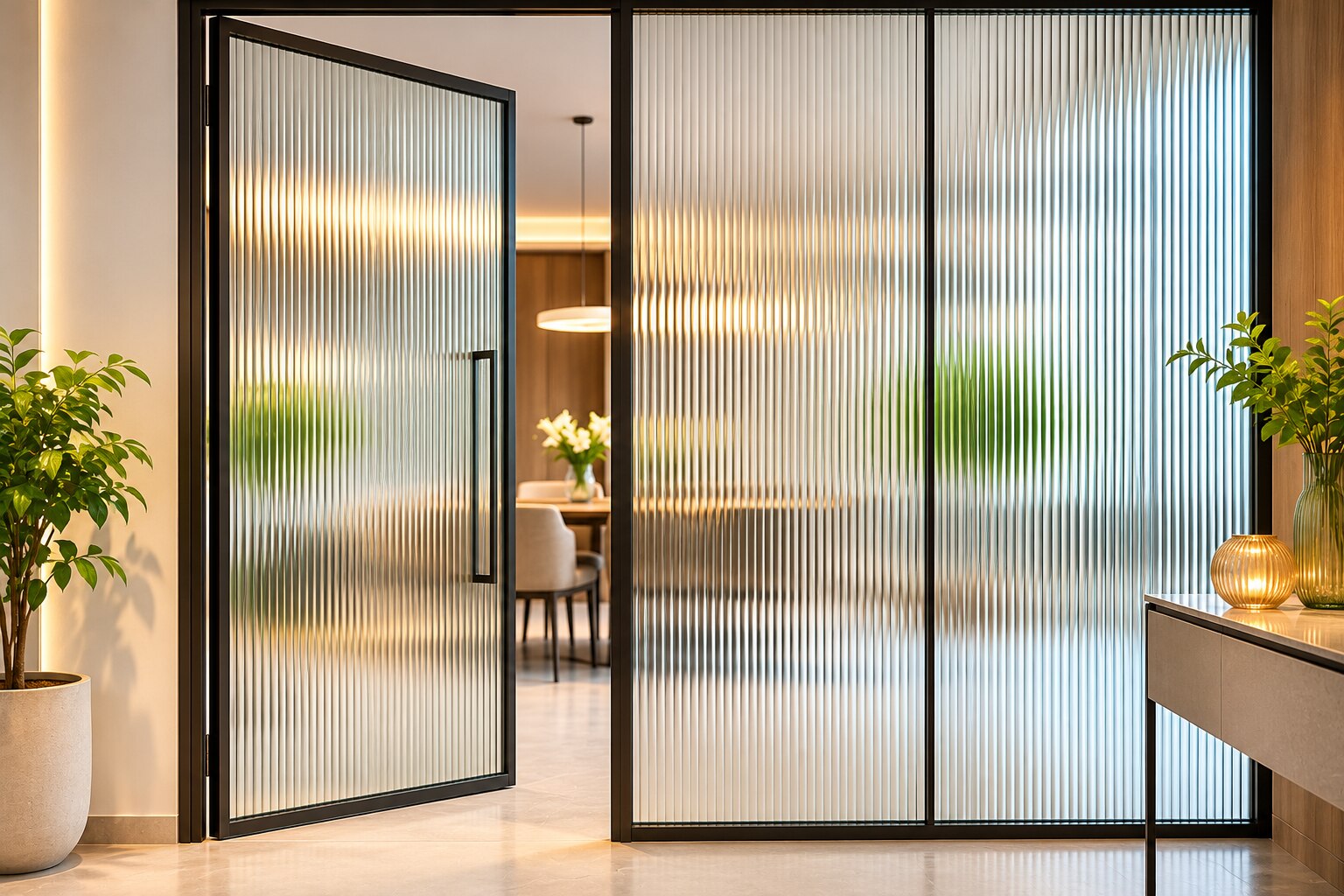
Fluted glass suits pivot doors, hinged doors, sliding doors, wardrobe doors, shower enclosures, room dividers, and cabinet fronts when the pane, hardware, and frame are designed as one system. Framed construction is the forgiving choice: aluminium or timber frames support the edges and hide small pattern-related tolerance differences.
Frameless doors need exact glass thickness, edgework, holes, clamps, seals, and clearances.
| System | Suitable construction | Check before ordering |
|---|---|---|
| Pivot doors | Frameless patch fittings or framed aluminium/timber leaf | Confirm door weight, pivot capacity, floor and head clearances, and the complete cut-out schedule |
| Hinged doors | Framed leaf, concealed hinges, or rated glass-door hinges | Match hinge load to pane size; protect exposed edges and confirm handle drilling |
| Sliding doors | Top-hung or bottom-rolling track with framed or captured glass | Check track capacity, anti-jump hardware, overlap, edge clearances, and pattern alignment |
| Wardrobe and cabinet fronts | Aluminium, timber, or slim steel frames; sliding or hinged | Confirm lighter-duty hardware, corner protection, and clearance from shelves or adjacent panels |
| Shower enclosures | Framed or frameless systems with approved clamps and seals | Specify safety glazing, wet-area edge protection, and hardware compatibility |
Fluting does not make glass safe. For a human-impact door, specify thermally toughened glass or laminated glass with a documented classification; EN 12600 covers pendulum-impact classification, while EN 12150 and EN 14449 cover toughened and laminated safety glass. Laminated edges need protection from moisture.
Send every hole, notch, hinge position, and handle dimension before heat treatment. A processor cannot safely drill or cut a toughened fluted pane afterward.
Choose Flute Direction, Depth, and Privacy Level
Flute direction controls whether a door feels taller, broader, or more visually active; flute depth and pitch determine how sharply it breaks the view. Vertical fluted glass draws the eye upward and organizes reflected highlights into vertical bands, while horizontal fluted glass emphasizes width and creates horizontal sightlines.
| Option | Appearance | Privacy effect |
|---|---|---|
| Vertical, narrow flutes | Adds height and a regular, tailored rhythm | Breaks faces into vertical strips; nearby silhouettes can remain clear |
| Horizontal, narrow flutes | Stretches the panel visually and emphasizes width | Interrupts recognition across horizontal bands, but does not guarantee privacy |
| Shallow, close-spaced flutes | Subtle texture with softer highlights | Reduces detail modestly while retaining more light and shape |
| Deep, wide-spaced flutes | Strong relief, shadow, and movement across the door | Produces greater visual distortion, but test silhouettes before approval |
Reeded glass usually describes narrow, repeated ribs, yet the name does not define flute depth, pitch, or privacy performance. Request a physical sample in the proposed orientation; a drawing cannot show how the ribs distort a face, furniture, or a bright window behind the panel.
Treat privacy glass as a performance target, not a product label. State the required viewing distance, the brighter side of the panel, and whether you need obscured faces, softened silhouettes, or only visual separation.
A close observer facing a brighter room may still see a strong silhouette through deeply fluted glass, so approve the sample under the actual lighting condition.
Control Light, Reflections, and Daily Cleaning
Place the fluted face away from hands, splash, and airborne dust whenever the glazing system allows it. An exposed groove face collects fingerprints, water marks, and cleaning residue; a flat face gives doors and panels a quicker daily wipe.
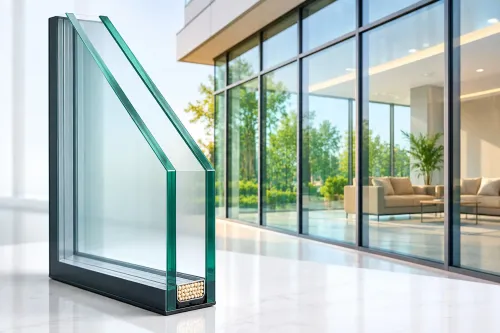
For an insulated glass unit, have the supplier approve the relief direction, cavity clearance, spacer, sealant contact, and edge construction before fabrication.
Use fluted glass lighting to avoid a bright source on one side and a dark space on the other. That contrast turns the flutes into harsh reflective stripes. Diffused light, concealed LED strips, and indirect wall or ceiling illumination soften the pattern; avoid aiming a bare spotlight straight across the grooves.
Check the finished sample from the actual viewing position, not only under a showroom ceiling.
- Keep bright windows or luminaires out of the direct reflection line when glare matters.
- Do not place a strong light behind a person if recognizable silhouettes must stay hidden.
- Balance illumination on both sides of a divider or door; backlighting makes outlines more visible through translucent glass.
- Inspect the chosen fluted glass surface finish with fingerprints, dust, and the intended lamps switched on.
For textured glass cleaning, use a soft microfiber cloth and a non-abrasive glass cleaner, working along the grooves. Never use a scraper, scouring pad, or gritty powder on the relief. This routine matters in decorative glass interiors, especially at hand height and beside cooking or shower areas.
Compare Fluted Glass with Other Decorative Options
Choose fluted glass when you want directional privacy, vertical rhythm, and moving shadows rather than a flat finish. It is less suitable when maximum transparency, uniform concealment, or the easiest cleaning surface matters.
| Option | Advantage | Choose it instead when |
|---|---|---|
| clear glass | Maximum view and daylight; easiest surface to wipe. | You need transparency; choose fluted glass when directional privacy matters. |
| frosted glass | Uniform diffusion and privacy without a directional pattern. | You need full concealment; fluting gives greater depth and visual movement. |
| acid-etched glass | Consistent matte translucency with a refined appearance. | You want a smooth, even veil; fluting adds texture and stronger vertical emphasis. |
| sandblasted glass | Deep, tactile opacity and custom motifs. | You need artwork or high opacity; fluting suits a repeatable relief instead of a rough matte surface. |
| patterned glass | The broadest choice of motifs and privacy levels. | A specific design is the priority; fluting provides a quieter, regular rhythm. |
| tinted glass | Adds colour and reduces some glare, but does not guarantee privacy. | Colour or solar control matters more than texture; fluting avoids a strong hue. |
| laminated glass | Retains fragments and accepts acoustic interlayers. | Safety, sound control, or security leads; fluting can form one laminated ply, not replace it. |
For a door, decoration is not safety glazing: specify thermally toughened or laminated construction and an impact classification such as EN 12600, with EN 12150 or EN 14449 where applicable. Fluting alone also promises neither acoustic insulation nor thermal performance; compare the complete build-up, seals, frame, and U-value.
Write a Fabrication-Ready Fluted Glass Specification
Before ordering, put these details on one approved drawing; a verbal request leaves the processor guessing about hardware, edges, and orientation.
1. State the application and finished pane size: hinged, pivot, sliding, wardrobe, shower, divider, or cabinet front. Include the opening direction, frame or frameless system, support points, clearances, seals, and hardware model.
2. Select the safety glazing construction. Specify toughened fluted glass or laminated fluted glass, nominal thickness, and the required safety-glazing classification. For a European specification, state the required EN 12600 pendulum-impact class; reference EN 12150 for thermally toughened glass or EN 14449 for laminated glass.
3. Record the decorative geometry: flute pitch, depth, orientation, surface finish, and whether the relief is on one face or both. Name the room-facing side so the installer cannot reverse the pattern.
4. Approve every fabrication detail before tempering: polished or arrissed edges, corner radii, holes, notches, hinge cut-outs, lock cut-outs, and handle positions. A toughened pane cannot be drilled or cut afterward.
5. For laminated fluted glass, specify the interlayer, total build-up, edge cover, and whether any laminated edge remains exposed. Unprotected edges invite moisture ingress and delamination.
6. State whether acoustic, solar-control, low-emissivity, or condensation performance is required. Fluting alone is not an acoustic or thermal specification; framing, seals, airspaces, coatings, and installation determine those results.
7. Have Jivan Industries confirm the approved sample, glass build-up, tolerances, packing, and installation orientation before production.
Related products
 | SAFTEY Keeping full focus on the industry set quality standard, we are persistently offering an affordable spectrum of Toughened Glass to our clients in... View product → |
 | A double unit comprises of two panes of glass. These two panes of glass are held apart by a spacer bar. View product → |
Frequently asked questions
Which door construction works best with fluted glass?
Framed aluminium or timber doors provide the most forgiving support and conceal small pattern-related tolerance differences. Frameless doors require closer coordination between glass edges, holes, hinges and seals.
How do flute direction and depth affect privacy?
Vertical or horizontal flutes change the visual rhythm and sightlines, while deeper flutes distort views more strongly. Choose the pattern after checking privacy from both sides and at typical viewing distances.
How do you control cleaning and reflections on fluted glass?
Review the flute profile, lighting position and access to both faces before ordering. Dust and fingerprints collect in the grooves, so specify enough cleaning access and use a soft cloth with a mild, non-abrasive cleaner.
What should a fabrication-ready fluted glass specification include?
State the glass type and thickness, safety treatment, flute direction and profile, finished dimensions, edgework, holes, notches, tolerances, hardware locations, frame details and intended application.
Related product
 | Laminated Glass is a safety and security glass that is made by sandwiching a laminated sheet between two pieces of glass. View product → |