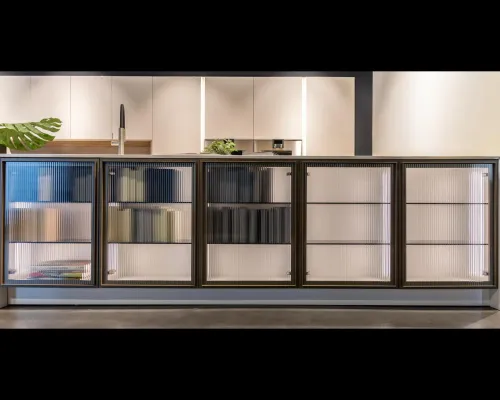

A failed mirrored insulating-glass unit cannot be replaced safely from a nominal width and height alone. You will need to identify the original build-up, measure the frame and sealed unit correctly, specify the mirror orientation and safety treatment, and confirm how the replacement will be handled and installed.
Key takeaways
- Confirm whether the mirror pane is the inner or outer DGU lite.
- Measure the removed unit, including overall thickness, spacer and coating orientation.
- Specify glass build-up, mirror finish, dimensions, edgework, sealant and delivery protection.
- Rule out frame drainage, installation and condensation faults before ordering replacement glass.
Can a mirror pane form one side of a DGU?
A mirror pane can form one side of a double-glazed unit (DGU). Specify the construction for the project:
- mirror/clear
- mirror/low-E
- mirror/laminated
The mirror coating normally sits on the protected rear face of the mirror pane. It must not face the weather, and it must not be left toward the cavity in an orientation that exposes the coating or gives the wrong visual effect.
State which way the reflective surface must face:
- the room
- the façade
- the cavity
Viewing direction changes the appearance, reflection and installation orientation. Confirm this before fabrication, not after the sealed unit reaches site.
Controlled edge deletion is essential. Cutting, drilling or grinding after manufacture, or removing the protective backing, can expose the silver layer. Moisture then causes black-edge corrosion. The supplier must define the deleted edge width and protect the coating termination within the perimeter seal.
A reflective appearance does not prove solar-control or low-E performance. Request the target U-value, solar factor, low-E position and air or argon fill; a mirror surface alone confirms none of them.
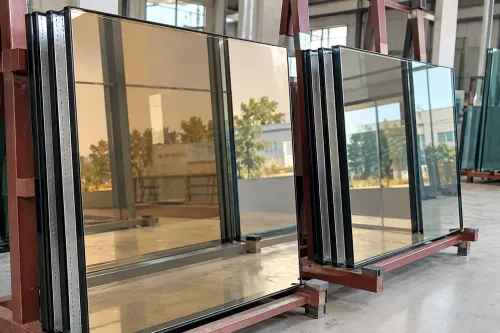
Buy mirror glass for builders as a fabricated sealed unit, not as a stock mirror sheet. A mirror DGU supplier needs the finished dimensions, pane thicknesses, cavity, spacer, seal, defined edge and safety construction. Use laminated or toughened safety glass where doors, low-level glazing, partitions or impact exposure demand it.
How do you identify and measure the failed replacement unit?
Measure the failed unit, not just the opening, before ordering dgu replacement glass. A double glazing replacement can match the width and height yet fail because its thickness, edge clearance or position within the frame differs from the original.
1. Record the complete sealed-unit width and height, overall thickness, each pane thickness, spacer width, spacer material and colour, and any offset of the unit inside the frame.
2. Identify air or argon fill evidence, such as a gas-fill label, valve or supplier record. Photograph every low-E marking, spacer stamp, corner construction and visible seal.
3. Keep these measurements separate: visible glass size; frame rebate or glazing-pocket size; and complete sealed-unit size, including edges hidden by beads, gaskets or sealant.
4. Check glass bite, edge clearance, pocket depth, setting-block positions, drainage slots, gasket or sealant type, and the unit’s installation orientation.
5. Measure both diagonals. Record the difference between them and note every out-of-square condition rather than forcing a rectangular assumption.
6. If removal is safe, measure the old unit directly and photograph its spacer, markings, corners and edge. A nominal opening size cannot establish the correct total thickness.
Use the recorded dimensions to confirm the replacement’s cavity, pane build-up and offset before fabrication. Never order from width and height alone: a unit that is too thick will not seat, while insufficient edge clearance can cause glass contact, seal damage or breakage.
What must the purchase order specify?
1.
Write the unit as a fabricated specification, not “mirror DGU”: finished width × height, dimensional tolerance, pane build-up such as 6 mm mirror/12 mm cavity/6 mm clear, cavity width, air or argon fill, spacer type and colour, primary and secondary sealants, total unit thickness, mirror colour and finish, reflective-face orientation, edge-deletion width, corner and edge-sealing method, low-E coating if required, and installation orientation.
2. Require the mirror DGU supplier to state whether each pane is annealed, heat-strengthened, tempered or laminated. For doors, low-level glazing, partitions and impact-risk locations, specify the applicable safety construction instead of ordinary annealed mirror.
Tempered glass cannot be cut or drilled after processing; laminated glass remains held together after breakage but changes thickness, weight and fabrication requirements.
3. Add the frame’s glazing-pocket depth, glass bite, rebate, setting-block arrangement and drainage path to the order. Request unit-level traceability for glass composition, pane thickness, cavity, spacer, sealant, gas-fill declaration, dimensions and safety marking. Require a warranty covering inter-pane fogging and mirror-edge corrosion specifically; a vague glass warranty does not cover either failure.
Record these requirements when ordering DGU replacement glass.
Is the problem a failed DGU seal or a different glazing fault?
Condensation between the two panes, visible inside the sealed cavity, indicates perimeter-seal failure. Wiping either exposed glass surface or applying a film will not remove it. A double glazing replacement requires the complete sealed unit, not an on-site attempt to open and re-seal it.
Room-side condensation forms on the indoor glass face and depends on indoor humidity and surface temperature. Water at the frame points to a different investigation: inspect blocked weep holes, failed perimeter sealant, leaking gaskets, and roof or façade connections before blaming the DGU.
A dull, spotted or blackened mirror edge indicates coating damage or edge corrosion, not automatically a failed cavity seal. Use this diagnostic record before commissioning a replacement:
- Photograph the room face and façade face, frame corners, drainage points, spacer markings, mirror edge and every fogging pattern.
- Identify where moisture sits: between panes, on the room-side surface, or around the frame. Mark the location on the photographs.
- Check weep holes for blockage and inspect joints, gaskets, sealant lines and adjacent roof or façade construction for an entry path.
- Provide the original drawing, sample glass, unit label, batch or order record and site measurements when available.
- Ask the supplier to confirm the replacement boundary: remove and refit the complete sealed unit, preserving its specified spacer, sealant, cavity and mirror orientation.
Do not accept a field re-seal as equivalent to a factory-sealed unit; it may not restore moisture protection or gas retention.
How should builders evaluate supply, handling and installation across both states?
Two 6 mm panes weigh about 30 kg per square metre before adding the spacer, sealant, laminate or hardware.
Treat a replacement as made-to-measure, not as stock glass with a guaranteed delivery period: lead time follows measurement approval, mirror and safety processing, spacer and gas-fill availability, production checks, transport distance, site access and removal of beads or old sealant.
- production date and dispatch condition;
- delivery district in Chhattisgarh or Odisha;
- inspection procedure on arrival;
- installation responsibility;
- unit dimensions, build-up, safety treatment and traceability.
2. Require traceability for glass thickness and composition, cavity, spacer, sealant system, gas-fill declaration and safety marking. The replacement warranty must address inter-pane fogging and mirror-edge corrosion, not just state “five-year glass warranty.”
3. Specify upright, protected transport racks for large units. Store them upright in a dry place, away from abrasive contact and trapped water; use lifting equipment rated for the unit and suited to the opening.
4. Before fitting, check frame load, setting-block positions, glass bite, drainage, pocket clearance, gasket or sealant condition and the opening’s access route. After fitting, inspect the mirror edge, gaskets, sealant line and bead seating.
For anyone searching “mirror dgu for replacement supplier odisha in chhattisgarh,” fabrication, measurement review, traceability and site coordination matter more than the keyword. Jivan Industries is a Raipur-based supplier to assess against those records, with availability, district coverage and installation scope confirmed before ordering.
Related product
 | A double unit comprises of two panes of glass. These two panes of glass are held apart by a spacer bar. View product → |
Frequently asked questions
Can a mirror pane form one side of a DGU?
Yes. A mirror pane can form the inner or outer lite, but the purchase order must state its position, thickness, coating orientation, spacer and overall DGU build-up.
How do you identify and measure a failed replacement DGU?
Record the opening size, removed unit’s overall thickness, each glass thickness, spacer width, seal condition, edge details and any markings before ordering. Measure the frame rebate separately from the visible glass.
What must a mirror DGU replacement purchase order specify?
State the glass types and thicknesses, mirror position, coating orientation, spacer material and width, cavity gas if required, sealant, edge finish, dimensions, tolerances, quantity, packing and delivery location.
How can you tell a failed DGU seal from another glazing fault?
Persistent fogging or liquid between the panes points to insulating-glass seal failure. Condensation on a room-facing surface, leaks at the frame, drainage blockage, failed gaskets or installation gaps indicate a different fault.
How should builders evaluate mirror DGU supply across Chhattisgarh and Odisha?
Compare fabrication records, measurement checks, protective packaging, transport arrangements, site unloading, installation responsibility and replacement terms. Confirm the supplier can deliver to the project location in the required sequence.
Keywords