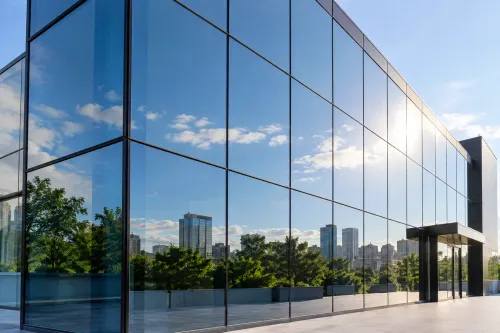
Fast sourcing depends on more than finding a dealer with reflective glass on a warehouse list. You need to confirm the laminated build-up, fabrication sequence, dispatch location, processing dates and site-delivery conditions before comparing quotations. By the end, you will have a brief you can send to suppliers and a method for checking whether the quoted glass suits your project.
Key takeaways
- Confirm physical stock and delivery routes before requesting a price.
- Define reflective coating, glass thickness, interlayer and panel sizes.
- Send drawings, quantities and edge requirements to prevent fabrication rework.
- Compare transport, packing, handling and installation costs with the glass rate.
Treat the Search as a Production and Delivery Enquiry
A search for a reflective laminated glass supplier for odisha in chhattisgarh is a production-and-delivery enquiry, not a local-stock check. Ask whether stock is physically available in Raipur, Bhilai, Bilaspur, Korba, Sambalpur, Jharsuguda, Rourkela, Bhubaneswar or Cuttack.
Request these details in writing:
- Coating location, fabrication city, dispatch city and actual ready-to-load date.
- Site-delivery coverage by district and the transporter’s name.
- Unloading equipment required at the project site.
- Responsibility for road damage, inspection and replacement.
Confirm four dates before comparing quotations:
| Date | What it confirms | What can still be outstanding |
|---|---|---|
| Base-glass availability | The uncoated glass is available | Coating and fabrication |
| Coating availability | The specified coated glass is ready | Lamination and cutting |
| Lamination completion | The laminated assembly is finished | Inspection, packing and dispatch |
| Dispatch | The consignment leaves the stated city | Transit and site unloading |
“Ready stock” may mean only an unprocessed jumbo sheet. Cutting, drilling, heat treatment, lamination, inspection and packing can still add days, and drilling a finished laminated pane can damage the interlayer or coating.
Compare the landed delivery date, not the date of the first phone quotation. Check that transport uses an A-frame or vertical rack, dry separators and protected corners, then record scratches, edge chips, delamination and size deviations on the delivery note.
Confirm What “Reflective Laminated” Actually Means
Specify reflective laminated glass as an assembly, not a colour: two glass panes, a solar-reflective coating on a named glass surface such as surface 2, and a PVB or other interlayer between them.
State 6 mm glass + 1.52 mm interlayer + 6 mm glass in the purchase order, then name the interlayer material, colour and exposed surface.
Searches for “reflective laminated glass near me” can return ordinary reflective monolithic glass. Compare the construction before accepting the quotation:
| Option | Construction | What it provides |
|---|---|---|
| Reflective monolithic glass | One coated pane | Reflection without laminated post-breakage retention |
| Clear laminated glass | Two panes plus interlayer | Retention after breakage, without reflective coating |
| Toughened glass | Heat-treated single pane | Higher strength and thermal-shock resistance, but not equivalent cracked-glass retention |
| DGU | Two panes with air or gas cavity | Thermal performance; not automatically laminated |
| Reflective DGU | Coated pane plus cavity | Solar control and insulation; still not automatically laminated |
Bronze, grey or blue samples do not prove solar performance. Request these values for the exact build-up:
- Visible-light transmittance
- Solar heat-gain coefficient
- Shading coefficient
- Exterior reflectance
Factory lamination bonds the interlayer between panes, protects the assembly and gives consistent optics. Site-applied reflective film depends on edge protection, can show bubbles or variation, and is replaced as a surface layer rather than as a complete laminated pane. Confirm that the coating position suits lamination, weather exposure and cleaning.
Send a Quote Brief That Can Be Fabricated Without Rework
An absent hole location can turn available glass into a new-production order. Give the processor a fabrication-ready brief, not only the opening size, so reflective safety glass for glazing contractors can be quoted against a real production plan.
1. Send a pane schedule listing width, height, quantity, nominal thickness, glass colour, coating specification, visible-light-transmittance target, interlayer type and thickness, edge finish, required date and delivery address.
2. Attach a drawing for every hole, slot, notch, cut-out and corner radius. Dimension each feature from the same datum; mixed reference points create errors during CNC programming and fabrication.
3. State whether each pane is monolithic, laminated or an insulating-glass-unit component. Identify every operation required: cutting, edgework, drilling, CNC shaping, heat treatment and any fabrication after lamination.
Confirm the processing sequence before placing the order. The supplier must state whether the coating can be exposed, handled, cut, drilled, toughened or laminated after manufacture. Holes, notches and slots usually require completion before heat treatment and lamination.
Do not plan to drill a finished laminated pane. Drilling can damage the glass, coating or interlayer and can invalidate the processor’s warranty.
Ask for the manufacturer’s performance sheet, declared coating position and quality documents that reference the applicable edition of IS 2553. “Safety glass” alone does not identify the construction, processing limits or compliance evidence.
Match the Glass Build-Up to the Opening and Site Conditions
A pane that fits the opening can still fail if the frame cannot carry its thickness, weight or wind load. Match the build-up to the opening and site conditions before accepting the quotation.
1. Check the application—façade, curtain wall, shopfront, skylight, balustrade, door, canopy or interior partition—against pane size, design wind load and support condition. Confirm frame rebate depth, glass bite, setting-block position, drainage, compatible sealant and total weight.
2. Treat the interlayer as a performance choice. Standard PVB suits ordinary safety glazing; a stiffer ionoplast interlayer may suit large unsupported panes, overhead glazing or stronger post-breakage stability. Specify the interlayer type and thickness. Skylights, canopies and high-occupancy areas require safety-glazing design, not a generic “toughened reflective” purchase.
3. Get written confirmation of the coating surface and processing sequence. Coating position affects lamination, heat treatment, edge deletion, weather exposure and cleaning. The processor must confirm compatibility with the proposed system, including any soft coating. Complete holes, slots and notches before heat treatment and lamination.
4. Protect the finished panes in Chhattisgarh and Odisha: store them dry, protect edges, use compatible sealants and seal all holes. Standing water, poor edge cover and incompatible materials can cause edge whitening or delamination. Transport them on an A-frame or equivalent vertical rack with dry separators and protected corners; confirm site unloading equipment.
Inspect scratches, coating damage, edge chips, delamination and size deviations before installation, and record every defect on the delivery note before signing.
Compare Landed Quotations, Not Just the Glass Rate
Choose the quotation with the lowest landed cost, not the lowest square-metre rate. Add cutting yield, fabrication wastage, coating and interlayer premiums, packing, freight from the dispatch city, unloading, breakage allowance and replacement lead time. A cheaper pane can cost more when special-size production or a second fabrication movement delays installation.
| Route | Compare on | Risk to check |
|---|---|---|
| Odisha dispatch | Landed date, freight, unloading | Damage during road transport and limited replacement stock |
| Chhattisgarh fabrication | Fabrication completion, dispatch date, site delivery | Extra transit leg and handling movement |
| Special-size production | Yield, wastage, replacement time | Slow manufacture despite a lower glass rate |
A buyer seeking a reflective laminated glass supplier for Odisha in Chhattisgarh should request one written quotation containing:
- Build-up, coating surface, visible-light transmission and solar-performance values
- Fabrication scope, inspection documents and reference to the declared edition of IS 2553
- Fabrication city, dispatch city, transport method, A-frame packing and unloading equipment
- Site-delivery terms, breakage responsibility and replacement procedure
Compare an Odisha dispatch route with a Chhattisgarh fabrication route by landed date and damage risk, not distance alone. Jivan Industries can be compared with other regional suppliers when it documents the same construction and confirms coordination of fabrication and delivery to your project city.
For reflective safety glass for glazing contractors, accept the quote only when it matches the drawing, declared standard, processing sequence, delivery date and site-handling plan. Then issue the purchase order.
Frequently asked questions
How can you find reflective laminated glass near me quickly?
Ask suppliers whether panels are physically available in Raipur, Bhilai, Bilaspur, Korba, Sambalpur, Jharsuguda, Rourkela, Bhubaneswar or Cuttack, then confirm dispatch time and delivery route.
What does reflective laminated glass include?
Confirm the glass type, reflective coating position, pane thickness, interlayer material and thickness, colour, dimensions and edge finish. Do not accept the phrase “reflective laminated” without a written build-up.
What information should a glazing contractor include in a quote request?
Send panel quantities, width and height, glass build-up, coating specification, interlayer, edge treatment, tolerances, drawings, delivery location, access restrictions and required date.
How should you compare quotations from reflective laminated glass suppliers?
Compare the complete landed cost, including glass, fabrication, packing, transport, unloading, insurance, taxes, breakage terms and any site-handling charges—not only the per-square-metre glass rate.
Keywords