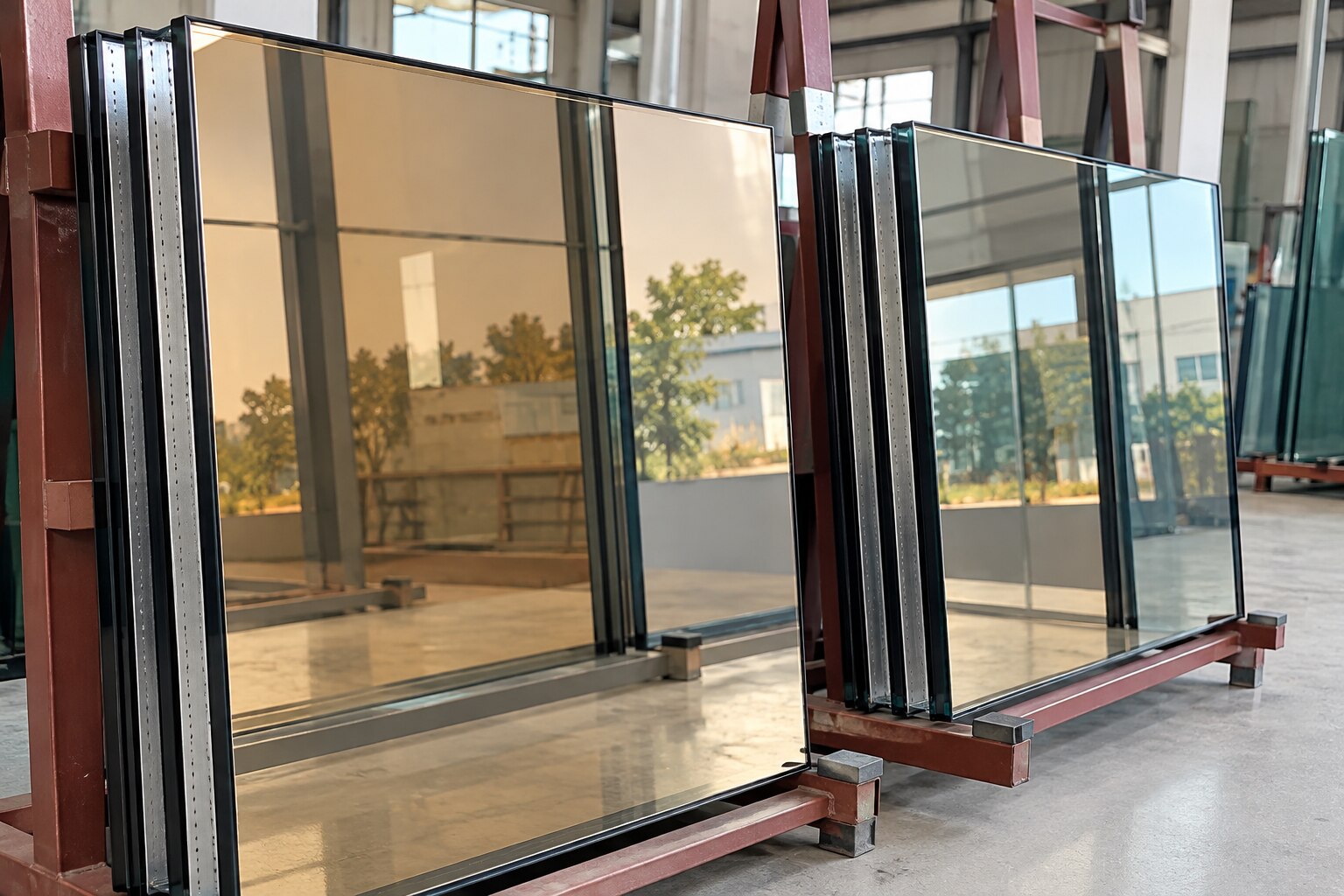
A request for “mirror DGU” is not specific enough for a reliable quotation: the supplier must know the mirror position, coating surface, cavity, gas, safety treatment, and final panel dimensions. By the end, you will know how to identify a fabricator serving Chhattisgarh or Odisha, compare technically complete quotations, and control delivery and installation risk.
Key takeaways
- Ask for proof the supplier fabricates complete mirror-faced DGU units.
- State mirror position, glass thickness, coating and safety requirements in the RFQ.
- Compare gas cavity, spacer, warranty and installation scope—not only the price.
- Approve drawings and inspection details before dispatch and site installation.
How to verify that a supplier actually fabricates mirror DGU units
1. Ask whether the company fabricates a complete mirror-faced insulating-glass unit, rather than selling ordinary DGU, a 5 mm mirror pane, toughened glass, or laminated glass separately. A separate mirror and DGU quotation does not prove the specified product exists.
2. Request the fabrication address, not only a sales-office location. For a Chhattisgarh project, confirm whether production occurs in Raipur or another plant, then request the proposed dispatch route and estimated transit plan to your site.
3. Search and record both “Orissa” and “Odisha” when finding a mirror dgu supplier or a mirror dgu units supplier for orissa in chhattisgarh. Put the legal consignee name and address on the purchase order, regardless of the search term used.
4. Ask the supplier to confirm delivery to Bhubaneswar, Cuttack, Rourkela, Sambalpur, Berhampur, or your exact project district. Regional service claims do not establish fabrication capacity or safe interstate delivery.
5. Request a photograph or drawing of a previous mirror DGU assembly, the proposed glass build-up, available unit sizes, and written delivery terms. The drawing must show the mirror position, glass thickness, cavity, spacer, and seal arrangement.
6. Require written confirmation that the complete sealed unit is manufactured and tested to IS 16231, including moisture-penetration and gas-retention performance. Also ask for fabrication and inspection records.
A supplier offering only a 5 mm mirror pane and a separate DGU has not demonstrated that it can fabricate the specified mirror DGU unit.
What to include in a mirror DGU request for quotation
A useful RFQ starts with a dimensioned schedule, not the phrase “mirror DGU.” For a dgu glass order in chhattisgarh, identify every opening by width, height, quantity and orientation: vertical façade, interior partition, door, overhead panel or sloped glazing.
- State each lite’s thickness and construction: monolithic, heat-strengthened, fully tempered or laminated.
- Identify conventional silver-backed mirror, coated architectural mirror or another reflective product. Specify the internal or external lite and the glass surface carrying the mirror treatment.
- State cavity width, spacer material, air or argon fill, required gas concentration, glass colour, low-E coating, edge treatment, and visible edge or rebate.
- Add every hole, notch, corner radius, cut-out and hardware position to the approved drawing. Confirm dimensions before tempering or heat strengthening; tempered glass cannot be cut, drilled or edge-worked afterward.
- Request centre-of-glazing U-value, solar factor or SHGC, visible transmittance, reflectance and design cavity where performance matters.
| Construction | Specify in the RFQ | Main consequence |
|---|---|---|
| Monolithic | Single pane, thickness and orientation | No post-breakage retention |
| Heat-strengthened | Thickness and heat treatment | Greater thermal resistance than annealed glass |
| Fully tempered | Thickness and safety requirement | Cannot be altered after tempering |
| Laminated | Glass thickness, interlayer and safety function | Retains fragments after breakage |
An architectural mirror glass dealer should provide a physical sample or mock-up for approval of mirror shade, reflectance, distortion, pinholes, scratches and visual uniformity. Photographs cannot reliably control appearance across a large batch.
How mirror position, coating and safety requirements change the specification
Approve the mirror location before production. A room-side mirror remains accessible for cleaning and inspection; a cavity-side reflective coating changes the edge-seal design. Ask the mirror dgu supplier to confirm edge deletion or coating removal, sealant compatibility, and the approved primary and secondary sealants.
| Location | Specification consequence | Check before approval |
|---|---|---|
| Room-side mirror | Accessible surface; keep the visible mirror border separate from the continuous insulating-glass edge seal | Confirm cleaning access and border dimensions |
| Cavity-side coating | Coating interacts with the edge seal and cannot be treated as ordinary glass | Confirm edge deletion, coating removal, sealant compatibility, and sealant system |
| Exterior lite | Solar absorption, thermal gradients, moisture, wind load, and edge durability can defeat conventional silvered mirror | Confirm an exterior-grade mirror construction or alternative build-up |
Do not assume a conventional silvered mirror suits an exterior lite. Treat mirror and DGU compliance as separate checks:
- Ask which silvered-mirror specification under IS 3438 applies, and which applicable parts of IS 2553 govern safety glazing.
- Require confirmation that the complete insulating-glass unit is manufactured and tested to IS 16231, including moisture-penetration and gas-retention performance.
- State whether post-breakage retention, impact safety, or overhead use is required. An IGU label does not provide that function; the laminated or tempered construction must meet the project requirement.
- Specify monolithic, laminated, heat-strengthened, or fully tempered glass, plus the internal or external lite, coating surface, cavity width, spacer, and air or argon fill.
- Reject “5 mm mirror” as a complete specification.
How to compare quotations with a standard mirror or another reflective glass option
Compare the complete assembly, not the quoted square-metre rate. Ask every architectural mirror glass dealer or mirror DGU supplier to complete the same schedule.
| Comparison | Mirror DGU | Alternative |
|---|---|---|
| Overall build-up | Total thickness; each pane; spacer material and width; air or argon fill; low-E coating; seal type; safety treatment | Record the equivalent construction, or mark it “not applicable” |
| Declared performance | Centre-of-glazing U-value, solar factor or SHGC, visible transmittance, reflectance, gas concentration and design cavity | Do not accept “double glazing” or “reflective” without figures |
| Standard wall mirror | Insulated cavity, heavier unit, deeper frame and sealed-edge maintenance | Shallower, easier to replace, but no insulated cavity |
| Single mirror pane | Simple and light, with no gas retention | No DGU insulation or gas retention |
| Laminated mirror glass | Interlayer retains fragments after breakage | Not automatically an insulating unit |
| Reflective coated glass unit | Can provide solar or visual reflectance | May not produce a room-side mirror image |
Compare DGU weight, frame depth, cleaning access, seal-edge maintenance and replacement difficulty before choosing the lowest rate. A replacement also needs the original coating batch; nominal thickness alone will not match its shade or reflectance.
Require an approved sample or mock-up for colour neutrality, reflectance, distortion, coating shade, pinholes, scratches and non-uniformity. Photographs are not acceptance criteria. Ask Jivan Industries to state these values and provide the same sample basis in its quotation.
Read the warranty for seal failure, coating deterioration, glass breakage and visual defects. Identify exclusions for site handling and cleaning damage. The warranty should name inspection responsibility, not quietly transfer every defect to the installer.
What happens after quotation: confirmation, dispatch and installation handover
After the quotation, control the order through a documented sequence: submit the enquiry and drawings, receive the quotation, resolve technical deviations, approve the final drawing and sample, issue the purchase order, confirm production, dispatch packed units, and complete installation handover.
- Repeat each unit’s dimensions, glass build-up, coating position, spacer, gas, safety treatment, holes, edge details, and approved appearance in the purchase order.
- Request traceability for glass type, coating batch, spacer, sealant, gas fill, manufacture date, and inspection records.
- Confirm crate design, vertical orientation, separators, corner protection, unloading equipment, route, delivery appointment, inspection timing, and responsibility for transit damage.
For a DGU glass order in Chhattisgarh, and when comparing a mirror DGU units supplier for Orissa in Chhattisgarh, price the delivered risk:
| Basis | Ex-works | Delivered |
|---|---|---|
| Cost | Factory pickup price | Transport and unloading included |
| Risk | Buyer arranges protection | Responsibility is assigned in writing |
| Inspection | Often delayed until site | Inspection timing is agreed before unloading |
Inspect crates before unloading. Photograph cracked corners, glass-to-glass contact, seal damage, spacer displacement, or broken packing.
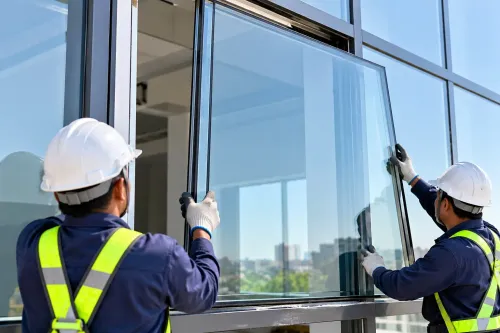
Confirm who owns site storage, glazing blocks, frame preparation, lifting, installation, cleaning, and final seal inspection. Do not allow site trimming, drilling, or edge work on a finished DGU; obtain supplier approval, then replace the pane or complete unit when dimensions change.
Frequently asked questions
How can you verify that a supplier fabricates complete mirror DGU units?
Ask whether the company makes the sealed insulating-glass unit with the mirror incorporated, rather than quoting ordinary DGU and a separate 5 mm mirror. Request a sample specification, production photographs, edge detail and confirmation of the mirror’s position within the unit.
What should a mirror DGU request for quotation include?
State panel dimensions, quantity, glass thickness, mirror position, cavity width, gas fill, spacer type, sealant, edge deletion, safety glass requirements, performance targets, delivery location and installation scope.
How do mirror position and coating change the specification?
A mirror on surface 1 faces the exterior, while a mirror on surface 2 sits behind the outer glass. Confirm the surface numbering, reflective appearance, coating compatibility, edge protection and cleaning restrictions before approval.
How should you compare mirror DGU quotations?
Compare the complete technical specification, including cavity size, gas, spacer, U-value, solar-control performance, safety treatment, sealants, warranty, packing, freight, unloading and installation. A lower price is not equivalent if these items differ.
What happens after a mirror DGU quotation is accepted?
Confirm approved drawings, dimensions, glass build-up, opening direction, pack sizes, delivery sequence and inspection criteria. Before dispatch, check labels and edge condition; at handover, record installation, glazing blocks, sealant and damage status.
Keywords